
Revenue Growth Alignment
If Revenue Plateaus While Your Client List Expands, It's Time To Look At Your Revenue Growth Alignment.
If you're operating a $5M - $50MM company and you're having trouble scaling even as your client list continues to grow, that's a clear sign that your revenue growth system is misaligned.
The misalignment causes revenue friction: a slowing in your growth and scalability due to a disconnect in the four pillars of revenue growth - Positioning, Productization, Pricing, and Packaging. When friction is present, these pillars pull against one another instead of operating like a system, slowing your growth even as your client list expands.
Diagnosing and correcting this misalignment will restart your growth. This is the process we call Revenue Growth Architecture.
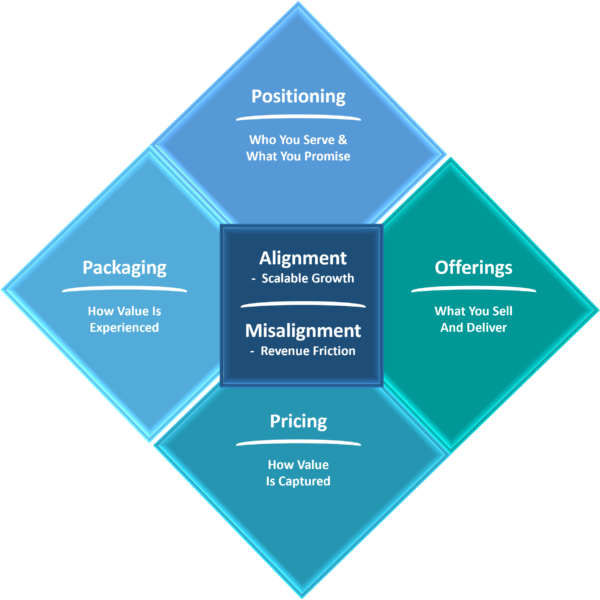
What Is Revenue Growth Architecture?
Revenue Growth Architecture is a strategic, framework-driven approach to engineering revenue generation. It is an approach that designs and engages the four-pillars that support revenue growth - positioning, offerings, pricing, and packaging – as one connected system, rather than four separate projects.
- Positioning determines whether the market understands what you do.
- Offerings determine whether what you sell is structured to be bought.
- Pricing determines whether the value you create is actually captured.
- Packaging reduces client confusion, makes intangible work feel tangible, speeds up buying decisions, and helps firms scale.
Revenue growth is not accidental - it happens by design, whether intentionally or not. Our Revenue Alignment Framework turns revenue growth into an intentional, scalable system.
What Most Companies Misunderstand About Revenue Growth
Most companies treat positioning, offerings, and pricing as three separate problems, handled by three separate people, on three separate timelines. They are not separate. They are three pillars of a four-pillar business growth system.
The fourth pillar - packaging – is the key that bundles intangible expertise, time, and solutions into a clearly defined, easy-to-understand service product with a set price and scope. Together, these pillars create a revenue generation engine that enables your business to grow faster and scale more predictably.
These pillars must be aligned, much like pillars holding up a roof on a structure. When one is misaligned, the others absorb the damage: Sales teams need to overexplain a fuzzy position. Marketing oversells an underpriced offer. Growth stalls in ways that look like an execution problem but isn't. It's what we call Revenue Friction - where two or more of the pillars are fighting against each other instead of working in unison toward achieving your growth goals.
We understand how these factors need to be integrated to drive consistent, scalable, and sustainable growth. Most business leaders were never taught to think this way.
How Do We Help You Turn Market Insight Into Measurable Growth?
Many companies invest heavily in marketing but still struggle to achieve consistent revenue growth. The issue is rarely effort. More often, the problem is that these core elements that drive revenue are not fully aligned.
Growth does not come from marketing activity alone. It comes from the alignment of the four pillars of revenue growth:
- A clear position in the market
- Well-structured offerings
- Pricing that reflects the value delivered
- Packaging and delivery that shapes the customer experience, delivers the value, and determines whether growth scales smoothly or strains under its own weight
When these elements work together, marketing becomes far more effective and sales conversations become much easier. When they are misaligned, companies generate interest but struggle to convert it into revenue.
Revenue Friction is most common at growth-stage inflection points, when a company scales past the model they used to build the early success. It's a pattern our Revenue Alignment Model is built to diagnose and correct. Through market research, strategic analysis, and structured planning, we find the revenue friction and eliminate it by connecting these pillars in a way that supports sustainable, and predictable, revenue growth.
Our proprietary approach brings you better results and faster revenue growth while reducing your overall marketing costs. This methodology has been proven successful with clients across a broad range of industries and over decades of experience.
This is a defined engagement, not an ongoing relationship. We diagnose where the system is misaligned, rebuild the structure across all four pillars, and hand you a roadmap your team can execute.
How Does Revenue Architecture Improve My Profits?
Revenue Growth Architecture is a bounded engagement built around three phases:
Phase 1: Market and Revenue Opportunity Analysis
We conduct research that reveals where your company can compete most effectively: market landscape analysis, buyer insight research, competitive positioning evaluation, and identification of high-value segments. The goal is finding where your strengths align with real demand.
Phase 2: Revenue Alignment Strategy
Once the opportunity is clear, we align positioning, offerings, pricing, and packaging so they work as one coherent system instead of four separate decisions. This includes strategic positioning development, offering design, pricing structure, and packaging strategy - connected, not sequenced.
Phase 3: Roadmap to Execution
Strategy only matters if it leads to action. We translate the alignment work into a roadmap your marketing and sales teams can execute: growth planning, marketing priorities, offer launch planning, and sales enablement guidance.
Who Is This Right For?
Companies at $1M–$50M, preparing for growth or already scaling, who have strong expertise that's difficult to communicate, are launching new services, entering new markets, or are running marketing activity without consistent growth to show for it.
Commonly Asked Questions
What causes revenue to plateau?
This is usually not a single failure but a mismatch between how the company positions itself, what it sells, how it prices, and how it packages and delivers. Any one of these can work fine in isolation while still creating friction together.
How do I know if my growth problem is structural or tactical?
If you've already added marketing spend, hired sales talent, or tried new campaigns without a lasting change in results, the constraint usually isn't tactical. Tactical fixes only work when the underlying structure can support them.
What's the difference between revenue architecture and a marketing plan?
A marketing plan focuses on channels and campaigns. This engagement addresses whether positioning, offerings, pricing, and packaging are aligned in the first place. Marketing only performs as well as that foundation allows.
Is this a one-time project or an ongoing relationship?
This is a defined engagement with a clear start, deliverable, and roadmap. If you're looking for ongoing, embedded revenue leadership instead, see Fractional Chief Growth Officer →.
What Questions Does Revenue Growth Architecture Answer?
Revenue Growth Architecture answers several questions that many organizations never fully address.
- Who are the clients you should focus on?
- What problems do you solve better than alternatives?
- How should your services be structured so buyers understand their value?
- How should those services be priced to reflect the outcomes they deliver?
When these questions are answered clearly, marketing stops feeling like guesswork and starts operating as a focused growth engine, giving marketing, sales, and leadership a shared foundation to work from.
A Focused Revenue Growth Conversation
If you are evaluating how well these elements are working together in your organization, we offer a focused introductory discussion. This conversation is designed to:
- Clarify your current growth priorities
- Identify potential gaps across positioning, offerings, pricing, and marketing
- Share practical perspective based on similar situations
Many organizations find that this discussion alone brings greater clarity to where growth efforts should be focused.
Schedule a Conversation
If strengthening your revenue strategy is a priority, we would welcome the opportunity to talk.