
Revenue Growth Strategy: How to Fix What’s Slowing Your Revenue Growth
You Need Alignment to Generate Scalable Growth
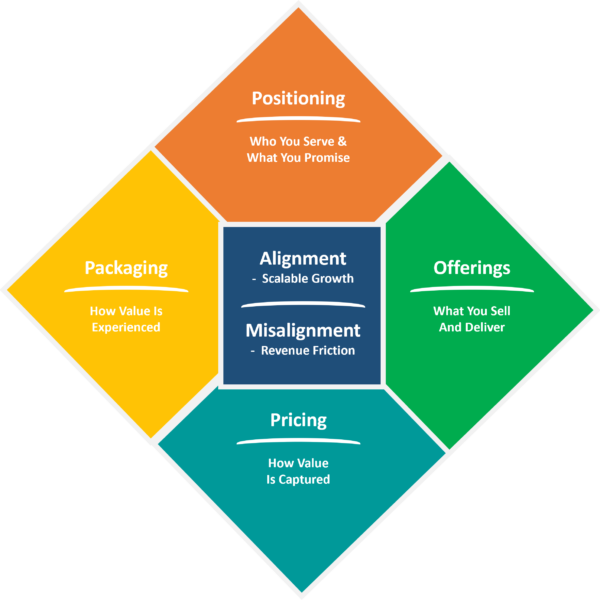
When revenue growth slows or stalls, most companies land in the same place: “We need better marketing.” So, they refine messaging, test new channels, and increase their marketing spend. These are all reasonable actions, if the problem is execution, but growth doesn’t usually break at the execution level. It breaks at the system level.
You need a revenue growth strategy to fix revenue friction. A revenue growth strategy defines how your company generates consistent, scalable growth. It is not just marketing. It’s the alignment between four core elements:
- Positioning – who you’re for and why it matters
- Offerings – what you sell and how it’s structured
- Pricing – how value is communicated and captured
- Packaging - how value is experienced
Once these four critical elements are aligned, the final marketing and sales can be brought into the mix and the Go-to-Market Strategy will generate much better results.
- Marketing – how you bring all of that to market
- Sales – how you convert demand into revenue
In simple terms: Growth comes from how well these elements work together, not how much activity you generate. We apply our proprietary Revenue Alignment Model to ensure that these aspects of your business work together to remove Go-to-Market friction and make a unique, unforgettable impression in the market.
When these elements are misaligned, they create revenue friction: the resistance that slows or limits growth, even when effort is high. It shows up as:
- Inconsistent performance
- Low conversion despite strong activity
- Longer sales cycles
- Difficulty scaling what should be working
When results slow down, the instinct is to do add more campaigns, create more content, and optimize better. But if the underlying system is misaligned, more traffic doesn’t convert better, more leads don’t improve your pipeline quality, and more activity doesn’t create consistency. Better – or more - execution doesn’t remove friction. Alignment does.
At a certain point, it starts to feel like nothing works. That’s usually the signal that marketing isn’t the constraint.
Where Does Growth Actually Break Down?
Revenue issues show up in predictable ways:
- Marketing is active, but not producing meaningful results
- Leads are coming in, but they’re not the right fit
- Sales cycles are longer than expected
- Growth feels inconsistent or harder than it should be
These are often treated as separate problems, but they’re not. They’re symptoms of misalignment across the system. They work in concert to defeat your CFO’s best growth planning goals.
Before changing tactics, you need to step back and look at the system:
- Are we clear on who we’re for and why we win?
- Do our offerings match how customers actually buy?
- Does our pricing support or slow down decisions?
- Is our marketing reinforcing clarity—or compensating for confusion?
If there’s friction in any of these, it will show up in performance.
The Four Levers of Revenue Growth
Most growth problems are solved at the wrong level. Companies focus on:
- Leads
- Conversion rates
- Campaign performance
Instead of the system producing those outcomes. But revenue is not a series of disconnected activities. It’s the result of how well everything works together.
When you understand the levers of revenue growth, you can spot the misalignments better and get your business back on track. These four levers of revenue growth need to work in harmony or your growth will fall short of its potential. The specific levers are:
Positioning
Positioning defines where you compete and why it matters. If it’s unclear or too broad, everything downstream becomes harder.
→ Read more: What Is Revenue Friction?
→ Read more: Marketing Strategy vs Execution
Offerings
Offerings translate your capabilities into something customers can evaluate and buy. If they don’t align with the buying process, interest doesn’t convert.
→ Read more: Why Marketing Isn’t Driving Revenue
Pricing
Pricing is a signal, not just a number. If it’s misaligned, it creates hesitation or attracts the wrong customers.
→ Read more: How to Align Positioning, Offerings, and Pricing
Packaging/Delivery
How value is experienced
Packaging is where your promise is proven. It includes:
- fulfillment
- customer experience
- operational consistency
- ability to produce outcomes at scale
If your delivery cannot support the expectations set by positioning and pricing, the system breaks -regardless of demand.
Where does Marketing fit in this model? Marketing amplifies the system: if the system is aligned, marketing performs, if it’s not, marketing exposes the gaps.
→ Read more: Marketing Strategy vs Execution
Revenue growth isn’t just about execution. It’s about how well the core elements of your business work together. When they’re aligned, growth becomes more consistent and predictable. When they’re not, everything feels harder than it should.
If you’re trying to solve a growth problem and the usual fixes aren’t working, it may not be a marketing issue. It may be friction in the system.
Are you experiencing a structural revenue friction issue or an execution issue? Take our quick Revenue Friction self-assessment and find out!