
Pricing Strategy
Creating The Strategy To Reach Your Financial Goals
Pricing strategy is more than just setting a price. In the early days of a business, most founders set their pricing based on what their competitors are charging. While this may work in the earliest days of a business, it can quickly erode your profit margins.
When our Revenue Growth Architects review pricing strategy for early-stage companies, we frequently find that the company was not really competing with the defined "competitors." They may provide the same - or similar - services, but they also have a different offering structure, cost basis, and business model - and in many cases, the competitors' pricing was not even strategically determined.
Risking your financial future on someone else's mistake is a real issue in small to mid-sized businesses. And you're not alone if you've done this - it's a mistake we see, and correct, every day.
Improve Your Pricing And Your Profit
Pricing is one of the most powerful drivers of revenue and profitability, yet it is often approached cautiously or based on industry conventions rather than strategy.
Many companies set prices based on what competitors charge or what they believe the market will tolerate. While this approach may feel safe, it often leads to underpricing, missed revenue opportunities, and unnecessary downward pressure on margins. A strong pricing strategy reflects the value you create for clients and aligns with your overall market position.
When pricing is structured effectively, it reinforces the value of your offerings, supports - and increases - profitability, and helps attract the clients you want to work with.
Our Pricing Strategy Services - Designed To Help Business Growth
Pricing Model Design
Different services and markets call for different pricing approaches. The structure of your pricing should align with the way your services deliver value. We help companies design pricing models that fit their offerings and their market position.
Our work in this area includes:
- Evaluation of existing pricing
- Development of value-based and outcome-based pricing
- Design of tiered or graduated pricing models
- Pricing architecture for service portfolios
- Assessment of readiness to move beyond hourly or blended-rate billing
The goal is to create a structure that supports growth while maintaining clarity for buyers.
Pricing as a Growth and Exit Signal
How you price isn't just a revenue decision - it's a structural one. Buyers, investors, and acquirers increasingly read pricing discipline as a proxy for how scalable and well-run a company actually is. Predictable, systemized pricing signals a business that can grow without breaking; ad hoc or blended pricing signals the opposite, even when the underlying work is excellent.
This matters most for companies preparing for their next stage of growth - a funding round, a sale, or simply scaling past founder-led selling. We help structure pricing so it holds up under that scrutiny, not just at the next deal.
Revenue and Profit Optimization
Even small adjustments in pricing can have a significant impact on profitability. We work with companies to evaluate how pricing affects revenue, margins, and long-term sustainability. To ensure these align, we provide the following services:
- Margin and profitability analysis
- Identification of pricing opportunities
- Revenue model evaluation
- Scenario planning for pricing changes
The result is a pricing strategy that supports both growth and profitable financial performance.
Pricing Communication
Pricing strategy only works when sales teams can confidently explain the value behind the price.
We help organizations develop the frameworks their teams need to communicate pricing effectively and reinforce the value of their services during sales conversations. This may include:
- Pricing communication frameworks
- Value justification strategies
- Sales positioning guidance
- Alignment between pricing and messaging
When pricing and positioning work together, companies are able to benefit more from the value they create.
Common Pricing Questions
Should professional services firms move away from hourly billing?
Hourly billing rewards time, not outcomes, and it caps how much a firm can earn without adding headcount. Most firms don't need to abandon it entirely - but pricing built around value or results, even for part of the portfolio, tends to protect margin better as a company scales.
How do I know if I'm underpricing my services?
Underpricing happens much more often than overpricing, and both are equally detrimental to your growth.
Common signs that you are underpriced:
- Prospects rarely push back on price,
- Competitors with weaker offerings charge more, or
- Your best clients clearly express the value they see in the outcomes you deliver for the price they paid
Underpricing is usually a positioning problem wearing a pricing costume.
What's the difference between value-based and cost-based pricing?
Cost-based pricing starts with your time and expenses and adds a margin. Value-based pricing starts with the outcome the client receives and prices against that. The second approach generally supports higher margins, but it requires positioning and productization work to hold up credibly.
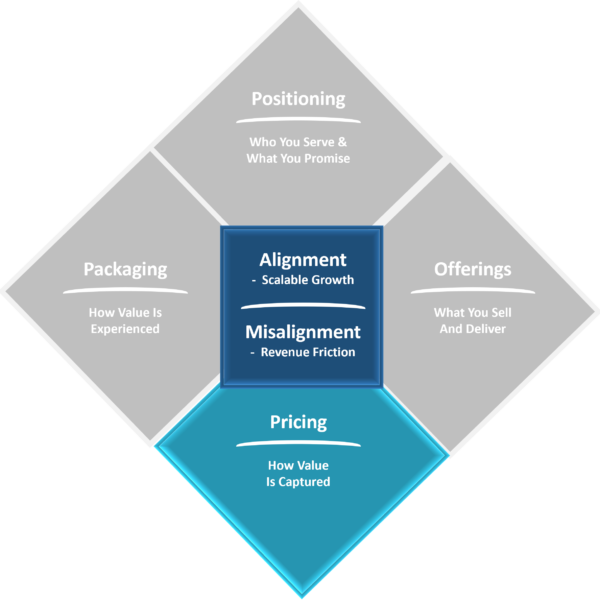
Pricing rarely works in isolation. It's one piece of a larger system that includes positioning and how your offerings are structured. Our Revenue Alignment Model explains why pricing pressure is so often a symptom of misalignment elsewhere, not a pricing problem on its own.