
Market Positioning Strategy
Market Positioning Strategy Requires More Than Defining Your Ideal Customer Profile
When you started your business, you were probably advised to choose and define an Ideal Customer Profile so colleagues would know who to refer to you. And, if you're like most leaders of $5M - $50M companies, you picked the profile of the client you wanted to do business with, and that worked - for a while.
But as your company grew, you began to feel more pushback from the same clients that enabled your early success. They may have started to talk about the differences between you and other companies competing for their business. Maybe you got more pushback on your pricing. Or maybe they simply "outgrew your services."
These are all signs of misalignment in your market positioning strategy.
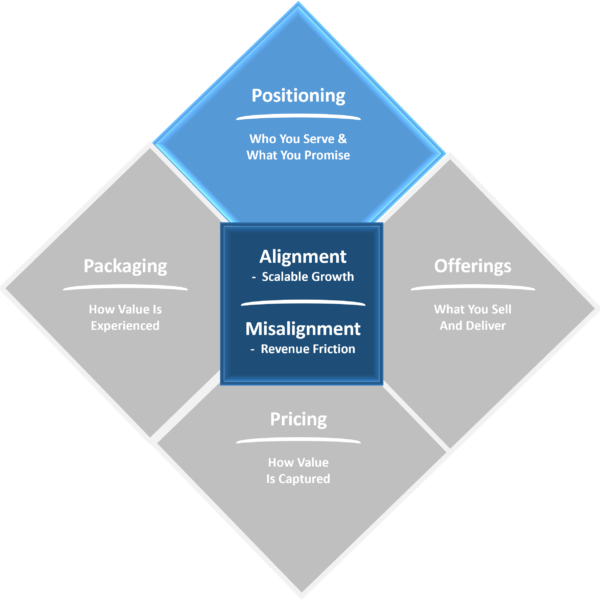
Defining What Makes Your Company The Obvious Choice
Most companies that struggle to grow are not in the wrong business. The problem is that their market positioning strategy is not clear. They do good work, and get results, but prospects still struggle to explain why they should choose them over a competitor.
Market positioning defines how your company is seen in the market. It explains why the clients you want should choose you. When it is clear, your marketing becomes more focused, sales conversations get easier, and your company starts attracting buyers who value what you do.
When positioning is vague, the opposite happens. Marketing pulls in leads that are not a good fit. Sales cycles drag on because buyers cannot see your value. Pricing pressure goes up because people see you as the same as everyone else. This is one of the most common - and most overlooked - causes of a stalled growth curve.
Strong competitive positioning matches what your company does best with the problems your best clients need solved. It makes your value clear. It gives the market a reason to choose you.
That clarity does not come from better copywriting. It comes from a structured brand positioning process- market research, competitive analysis, and strategic positioning work done in sequence, as one engagement.
Our work helps companies uncover that clarity and translate it into a strategic foundation that supports growth.
Not sure if your positioning is the problem? Schedule a free conversation and we can take a look.
Why Does Positioning Break Down Between $5M and $50M?
Growth plateaus rarely happen because a company stops trying. They happen because the positioning that worked to get a company to its current size stops being specific enough to get it to the next one. What once felt differentiated starts to sound like everyone else's pitch - not because the work changed, but because the market moved and the message didn't.
This is often mistaken for a sales or marketing execution problem. More activity gets added - more campaigns, more outbound, sometimes a new hire - and the results still don't move.
That's usually a signal the issue is structural, not effort-based: the company has outgrown its positioning before anyone noticed.
Positioning Your Company For Optimal Growth
You may have asked yourself “Why is our revenue unpredictable or inconsistent?” In many cases, you may have been told that all businesses have cyclical revenue – and that is true to an extent, but if your revenue cycles are not predictable, that’s a problem with positioning.
Good positioning starts with research, not guesswork. You need to know what the market actually looks like before you can decide where to compete. But not just any research. Research that enables you to determine
- Who really would value my offerings?
- Who is our best customer and how many are there in the market?
- Who are our competitors – not just those we know?
- How can we increase market share?
- How does the market perceive our company relative to others?
The result should present a clear picture of where growth is possible and where you can stand out - before any strategy is built. Ideally, you want a stranger to be able to quickly determine what you do, who they should compare your offerings to, and when they should choose you over other, similar companies. If the only thing they can use to compare you to competitors is pricing, you will always have inconsistent growth and low profit margins.
How Can We Help?
Companies usually come to us when growth has slowed and the cause is not clear. More marketing is not working. Sales cycles are too long. The team cannot explain why a prospect should choose them over a competitor. And frequently leadership believes they "need more leads."
You should call us when your company is:
- Losing ground or seeing revenue decline
- Growing beyond its original customers and carrying messaging that no longer tells a clear story
- Entering a new market segment or launching a new service
- Competing in a crowded market where it has become hard to explain what makes you different
- Facing pricing pressure that suggests buyers do not clearly understand your value
- Preparing for a new stage of growth and needing a strong foundation to build from
In each of these cases, the problem is the same: your positioning is not doing enough work in the market. More marketing will not fix that. A stronger strategic foundation will.
Common Positioning Questions
What is market positioning?
Market positioning is how your company is seen in the market relative to your competitors. It defines who you help, what problems you solve, and why buyers should choose you. A clear position makes your marketing more effective and your sales conversations shorter.
A market positioning strategy is a plan for how your company will stand out in the market. It includes your target audience, your value proposition, and how your offer is different from competitors. It guides how you communicate across marketing, sales, and every customer touchpoint.
Why does market positioning matter for B2B companies?
In B2B markets, buyers take time to evaluate options and compare vendors. A clear B2B positioning strategy helps prospects quickly understand what makes you different. This shortens sales cycles, reduces pricing pressure, and brings in leads that are a better fit.
What is the difference between positioning and branding?
Positioning is the strategy. It defines where you compete and why you win. Branding is how that strategy comes to life visually and verbally. Positioning comes first. Without it, branding has no clear purpose.
What is competitive differentiation?
Competitive differentiation is what makes your company meaningfully different from others in your market. It is not just about being different, it is about being different in a way that matters to your ideal clients. Strong differentiation makes it easier for buyers to choose you.
How long does a market positioning engagement take?
The full engagement - research, strategy, and messaging - typically takes eight to twelve weeks. The timeline depends on the size of the market, the number of competitors, and how much strategic alignment work is needed internally.
What are some signs of unclear positioning?
It shows up as longer sales cycles, lower close rates, and constant price pressure - because when buyers can't tell you apart from competitors, price becomes the only thing left to compare, leading to lower margin sales and bad-fit clients.
Over time, it also makes marketing less efficient, since undifferentiated messaging has to work harder to generate the same interest. If your team always has to explain why a prospect should choose you, it's usually a sign the market doesn't have a clear, specific reason to choose you over alternatives.
Can positioning fix a growth plateau on its own?
Sometimes - but positioning, productized offerings, and pricing usually need to move together. Strong positioning with a weak or unclear offering still won't convert consistently. Our Revenue Alignment Model explains why growth typically breaks in the gaps between these elements, not within any one of them.
Ready to build a position your market can act on? Set up a complimentary meeting and let’s talk about where the gaps are and what it would take to close them.