
Packaging Strategy
Packaging Strategy Is Key To Sustainable Growth
Packaging B2B services is much more than grouping things you can do and putting a price on the bundle. It's also different than tiered services.
Packaging is the method of creating value through the offerings you bring to market. It's developing a strategy for sustainability, cost-efficiency, brand awareness, differentiation, and the customer's experience.
When it's done right, packaging and delivery combine to create the "irresistible offer" every business owner wants to bring to market. It catapults early sales, generates repeat sales, increases Customer Lifetime Value (CLV), and enables sustainable scaling.
Turning What You Know Into Something The Market Can Buy Repeatedly
Most companies that struggle to scale don't have a demand problem. They have a delivery problem that looks like a demand problem.
From the outside, it shows up as inconsistent results client to client, project timelines that creep no matter how many times you scope them, and a sales team that can't tell a prospect exactly what they'll get without a custom proposal and a discovery call first. From the inside, it usually feels like flexibility - meeting each client where they are, customizing the approach, delivering exactly what this particular situation calls for.
That flexibility is often the thing quietly capping your growth.
What Is "Packaging"?
Packaging is the structure you wrap around your offering so it can be delivered the same way, by more than one person, without reinventing the process every time. It's different from productization, though the two work together closely. Productization defines what you sell. Packaging defines how it gets built, delivered, and repeated - the components, the sequence, the handoffs, and the documentation that let your offer scale beyond your own hands.
Without it, your best work stays trapped in your head, or in the heads of one or two senior people. Every engagement starts from a blank page. Every new hire takes months to ramp because there's nothing written down to ramp them into. And every client experience depends on who happens to be delivering it that week.
Where This Shows Up
- Your team delivers a strong result, but no one could explain the process well enough to repeat it exactly
- New hires take significantly longer to become productive than they should, because the knowledge isn't packaged, it's tribal
- Pricing feels arbitrary because the cost to deliver varies wildly project to project
- Client experience is inconsistent, and referrals undersell what you're actually capable of
- You can't take a vacation, or bring on a partner, without growth stalling in your absence
None of these are marketing problems. They're structural ones. More sales activity on top of an unpackaged delivery model just produces more inconsistency, faster.
How Packaging Connects To Positioning, Productization, And Pricing
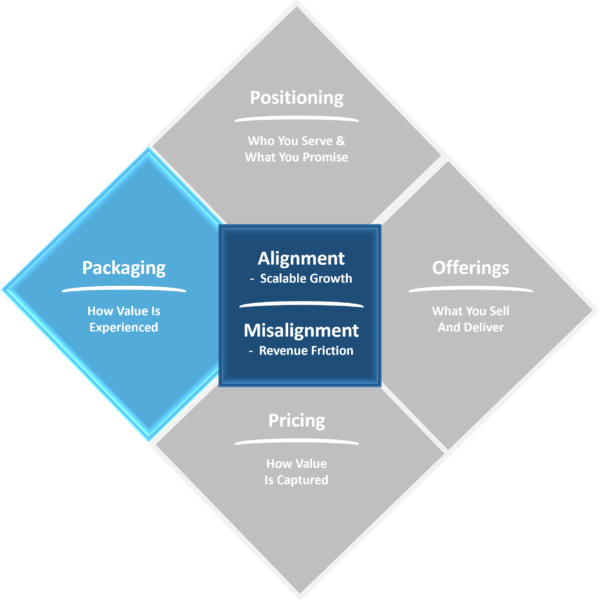
Packaging is the piece that makes the other three real. Positioning promises something specific. Productization defines the offer that delivers on it. Pricing sets what that offer is worth. Packaging is what proves you can actually deliver it - the same way, at the quality level you're promising, without you personally in every engagement.
Companies that skip packaging usually don't feel the gap until they try to scale: hire a second sales person, take on a client outside the founder's direct bandwidth, or raise prices to match the value they're already creating. That's when the lack of structure becomes the growth ceiling.
Our Packaging Strategy Offerings
We work with you to document, sequence, and systemize what your best delivery already looks like - so it becomes something your business owns, not something that lives in one person's head. That typically includes:
- Mapping your current delivery process end to end, including the parts nobody's written down
- Identifying where customization is adding real value and where it's just inconsistency in disguise
- Building repeatable frameworks, templates, and checkpoints your team can execute without you
- Structuring delivery so it can scale to a second hire, a second location, or a second market
The result is an offering your team can deliver with consistent quality, whether you're in the room or not.
Because packaging strategy impacts your pricing and productization strategies, and is influenced by the positioning, this service is optimized by inclusion in an integrated Revenue Architecture engagement. However, when the company has the other three pillars aligned properly, we can deliver this as a focused engagement. A quick conversation with us can help you decide which is the best option for you. Set a call up now!
Frequently Asked Questions
Isn't packaging just another word for productization?
They're related but not the same. Productization defines the offer - what's included, what's not, what it's called. Packaging is the operational backbone that makes that offer deliverable at scale. You can have a well-defined offer and still have no way to reliably deliver it.
Won't packaging make our service feel less custom?
Packaging the delivery process doesn't mean eliminating customization where it matters. It means being deliberate about where customization adds value and where it's just unmanaged variation. Most companies are shocked how much of what they call “custom” is actually just undocumented.
We're a small team - is this too early for us?
It's usually the opposite. The earlier you package delivery, the less unwinding you'll need to do later. Waiting until you're overwhelmed to systemize makes the process harder, not easier.
If your growth depends on you being in every engagement, you don't have a business yet - you have a very demanding job.