
Fractional Chief Growth Officer
Ongoing Growth Leadership - Not Another Marketing Vendor
In the early days of a business, a marketing agency with capable people is usually enough - they generate leads, they convert sales, and at that stage, that's the whole job.
Growth changes the job. As a company adds people, revenue, and complexity, tactics alone stop being sufficient. What's needed is a systematic approach to growth - one that connects marketing to revenue, not just to activity.
That's the gap a Fractional Chief Growth Officer is built to close. A CMO - fractional or full-time - is responsible for brand, tactics, and ensuring marketing spend produces the return growth requires. A CGO operates one level up: accountable for growth as a system, where marketing, sales, pricing, and positioning work together to produce predictable revenue.
For a $5M–$50M company trying to scale past its current plateau, that systemic view is usually the missing piece. If growth has started to feel like more effort for the same result, that's a sign the system needs realignment, not more marketing.
Let's talk about what a Fractional CGO could look like for your business.
What Is A "Fractional Chief Growth Officer"?
Revenue Growth Doesn't Come From an Outside Recommendation. It Comes From Leadership Inside the System.
Most companies believe they have a marketing problem. What they actually have is a growth alignment problem - and no one inside the organization owns fixing it.
[See how the four pillars of revenue growth work together →]
This is not a project with an end date. It's ongoing, embedded leadership - the role a high-performing CGO should play, without the cost or delay of a full-time hire.
What This Role Does
Rather than managing individual marketing activities, we hold four pillars - positioning, offerings, pricing, and packaging - in alignment on an ongoing basis, adjusting as the business, the market, and the team evolve.
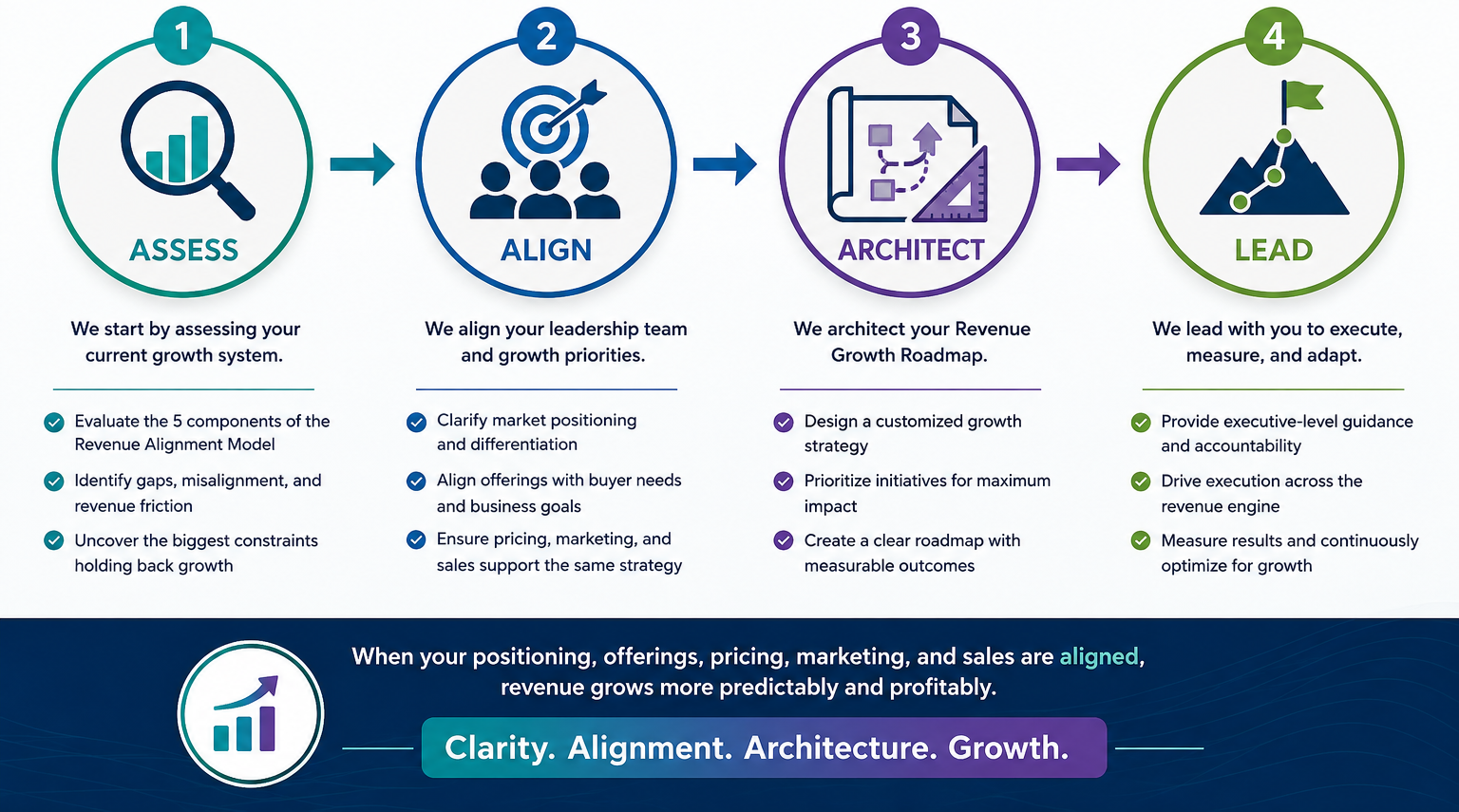
Assess. We evaluate the current growth system to identify where friction, missed opportunity, and structural constraint are limiting growth.
Align. We work with leadership to align positioning, offerings, pricing, and packaging around a shared growth strategy - not as a one-time exercise, but as a standing discipline.
Architect. We build and maintain a Revenue Growth Roadmap, prioritized by impact and feasibility, revised as conditions change.
Lead. We provide executive-level guidance on an ongoing basis - helping leadership execute the plan, measure results, and adapt. This is the continuity a single strategy engagement can't provide on its own.
We have decades of experience working in companies from start-up to hundreds of millions in ARR, leading their growth and scaling efforts. While some consultants tell you they are "growth marketing" or "performance marketing" experts, they do not have the business acumen or expertise to design and structure a company's revenue growth system.
Signs You Need A Fractional CGO
Hiring a fractional CGO is not the same as bringing in a consultant or agency for a one-time engagement. These are the signs that it's time for you to start working with a Fractional Chief Growth Officer:
- Growth has slowed or plateaued, and the causes are unclear or keep shifting
- Marketing activity is increasing but results aren't – and they may be getting worse
- Leadership teams disagree on priorities and growth strategy
- Leadership needs executive-level growth guidance without adding full-time headcount
- The gaps between positioning, offerings, pricing, and packaging keep reopening after they're fixed
When the system is misaligned, more marketing effort doesn't create growth. It exposes the gaps.
Who Is This For?
WHile our other services are great for companies between $1M - $50M in ARR, companies under $5M do not benefit as much from the services of fractional leaders of any type. That's why we have designed our Fractional Chief Growth Officer services to be ideal for:
- Founder-led companies, typically between $5M - $50M in revenue
- Companies preparing for their next stage of growth
- B2B service firms
- Technology companies
- Professional services organizations
- Businesses that need executive marketing and growth leadership without hiring a full-time employee
Most clients engage us when they have reached a point where experience, clarity, and strategic direction are more valuable than additional marketing activity. If you believe you have reached that point, but are still not at the $5M mark, set up a call. We're happy to discuss the benefits an FCGO can provide and if they are right for your company.
Why Do Companies Choose Foresight Performance?
Unlike traditional consultants who provide recommendations and leave, or tactical marketing providers focused on execution, we help leadership teams build and align the systems that drive sustainable growth.
Our approach combines executive-level marketing leadership, revenue strategy, pricing expertise, productization, and market positioning into a unified growth framework.
The result is a stronger revenue engine, clearer priorities, and a practical roadmap for growth.
But if we are not a good fit, we will also be honest with you about that.
Commonly Asked Questions
How is this different from hiring a full-time CGO?
You get executive-level growth leadership - aligning positioning, offerings, pricing, and packaging - without full-time cost or the ramp-up time of a new hire.
How is this different from a Chief Revenue Officer (CRO)?
A CRO focuses on leadership of the sales team to ensure the sales results are on-target for meeting revenue goals. They also create the compensation model for the sales team. While a very important role, the CRO is not typically tasked with aligning the company's Positioning, Offerings, and Pricing with the market, and they generally look to marketing to provide the packaging and presentation they rely on when speaking with customers and prospects.
Is this different from Revenue Growth Architecture?
Revenue Growth Architecture is a defined engagement: a diagnosis, an alignment strategy, and a roadmap, with a clear end point. Fractional Revenue Growth Leadership is ongoing - standing ownership of that alignment as the business and market continue to change. [Revenue Growth Architecture →]
Can this start with a project and become ongoing?
Yes. Most clients start with a Revenue Growth Architecture engagement and move into ongoing leadership once the initial alignment work is complete.
Ready To Identify What's Really Blocking Your Growth?
Schedule a Revenue Growth Assessment and discover where revenue friction is limiting your ability to scale.
Not sure that Revenue Friction is what's slowing your growth? Take our Revenue Friction Diagnostic, a complimentary self-assessment that gives you instant insight into where friction is creating a profit and margin leak.