
The Revenue Alignment Framework
Why Does Growth Stall Even When Nothing Seems Obviously Broken?
Revenue growth stalls are usually not the result of a marketing or sales problem. The cause is typically a much deeper, structural problem.
It shows up as inconsistent growth, poor conversion, pricing pressure, or stalled momentum. Teams are executing, investment is being made, and nothing is obviously “wrong.” And yet, growth doesn’t scale the way it should.
The issue is rarely within a single function. It exists in the gaps between them.
Growth breaks in the gaps, not in the parts
Businesses are typically structured around functions:
- Marketing generates demand
- Sales converts it
- Operations delivers it
Each function can be performing reasonably well on its own. But growth doesn’t depend on how well each part performs independently. It depends on how well they work together - as a system.
When there is misalignment between what you promise, what you sell, how you price it, and how it’s delivered, revenue friction is introduced, and it compounds as you grow
What Is The Revenue Alignment Framework?
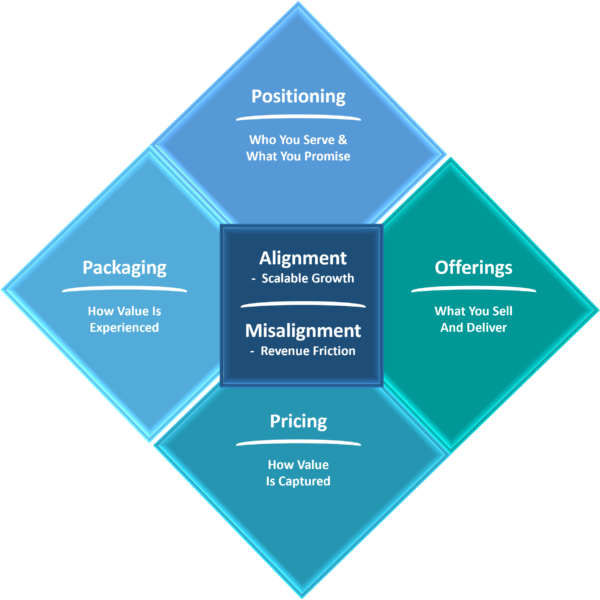
The Revenue Alignment Framework is our proprietary approach for identifying and correcting that friction. It examines four interdependent components.
When properly aligned, they create a system that drives revenue growth. That system makes growth more predictable, efficient, and scalable. When they are misaligned, effort increases but results don’t - and may even decline.
What Are The Four Components Of Revenue Growth?
1. Positioning: What you promise, and who it’s for
Positioning defines how your business is understood in the market. It shapes:
- Who you attract
- What they expect
- What they’re willing to pay
Weak or unclear positioning doesn’t just affect marketing performance. It distorts everything else downstream.
2. Offering: What you actually sell
Your offering is how your value is structured and delivered commercially. It includes:
- Scope
- Features and packaging
- Level of specificity
- How clearly outcomes are defined
An offering that isn’t tightly aligned to positioning creates confusion, slows decision-making, and reduces conversion.
3. Pricing: How value is captured
Pricing is not just a financial decision, it is a strategic signal that communicates:
- Perceived value
- Confidence
- Market positioning
When pricing is misaligned, it introduces tension:
- Too high → and you experience resistance and longer cycles
- Too low → and you generate margin pressure and undervaluation
4. Packaging: How value is experienced
Packaging is where your promise is proven. This includes:
- Fulfillment
- Customer experience
- Operational consistency
- Ability to produce outcomes at scale
Packaging is making sure that offerings are described clearly and positioned in a way that resonates with the buyers you want to attract. We package your offerings so they deliver on the brand promise and deliver the value your customers expect.
If packaging cannot support the expectations set by positioning, offerings, and pricing, the system breaks, regardless of demand.
Where misalignment creates friction
Most growth issues can be traced back to misalignment between these components. For example:
- Strong positioning + weak offering → Interest without conversion
- Premium pricing + inconsistent delivery → Churn and reputation erosion
- Solid offering + unclear positioning → Undervalued and overlooked
- Efficient delivery + misaligned pricing → Growth without profitability
These are not execution problems, they are structural conflicts.
Why execution alone doesn’t fix it
When growth stalls, most companies respond by increasing activity. They add to their marketing tactics, increase sales effort, run more campaigns, and offer more deals.
These can create short-term movement, but if the underlying structure is misaligned, it introduces more complexity without resolving the root issue. The result is more effort, higher cost, and limited improvement.
What revenue alignment actually changes
When positioning, offering, pricing, and packaging reinforce each other, your growths starts to feel different:
- Demand converts more efficiently
- Pricing pressure decreases
- Sales cycles shorten
- Delivery becomes more scalable
- Growth becomes more predictable
This is not because more is being done, but because the system is working and aligned.
How the framework is applied
The Revenue Alignment Framework is not theoretical.
It has been used and proven effective for decades. We use it to diagnose and correct structural constraints. Our process typically involves:
1. Diagnosis
Identify where misalignment exists across the four components
2. Isolation
Determine which conflicts are creating the most friction
3. Realignment
Restructure positioning, offering, pricing, and/or delivery so they reinforce each other
4. Support
Ensure execution is aligned to the updated system
When this matters most
This type of misalignment typically emerges when:
- A company is scaling beyond its original business model
- Offerings have expanded without clear structure
- Pricing hasn’t evolved with value
- Delivery has become more complex
- Growth has plateaued without a clear cause
As the company matures, execution improvements alone are not enough.
The Underlying Principle
Growth doesn’t break in a single function. It breaks in the relationships between them.
We designed our Revenue Alignment Framework to integrate all four pillars of revenue generation to deliver outstanding results.
If this feels familiar
If you’re seeing signs of friction in conversion, pricing, efficiency, or growth, there’s usually a structural reason behind it. Understanding where that misalignment exists is the first step to fixing it.
Let us find and fix your growth constraints!